What Is Holding You? /  by Alexander Lyadov

One of the barriers to change of any kind is the rut of the Mind.

It’s such a familiar way of perceiving your environment that you stop noticing it. Like the young fish who, when an older fish asked "So, how's the water today?", looked puzzled: "What water?"

You think, feel, and act only this way. Suggest shifting your perspective just a little, and the response is confusion: "What do you mean, differently? Isn't this obvious to everyone?" Then comes irritation, anger, and so on.

How do you create the perfect drama? Trap everyone in a circle. The vigilant prison guard and the escaping prisoner live inside the same mind.

The most dangerous prison has no concrete walls or steel bars. A man draws a line in the sand himself: “You can’t go any farther. Besides, I don’t even want to.”

This becomes visible during guided imagery sessions, where the design of the exercise places no limits on participants' imagination whatsoever.

And yet you suddenly hit what feels like a glass wall — unable to do something that others, or even everyone else, can do freely. Why?

The analysis that follows helps bring to light a pattern of thoughts, feelings, and behaviors, the conditions that trigger it, and its hidden meaning. What now blocks you so painfully may once have saved you.

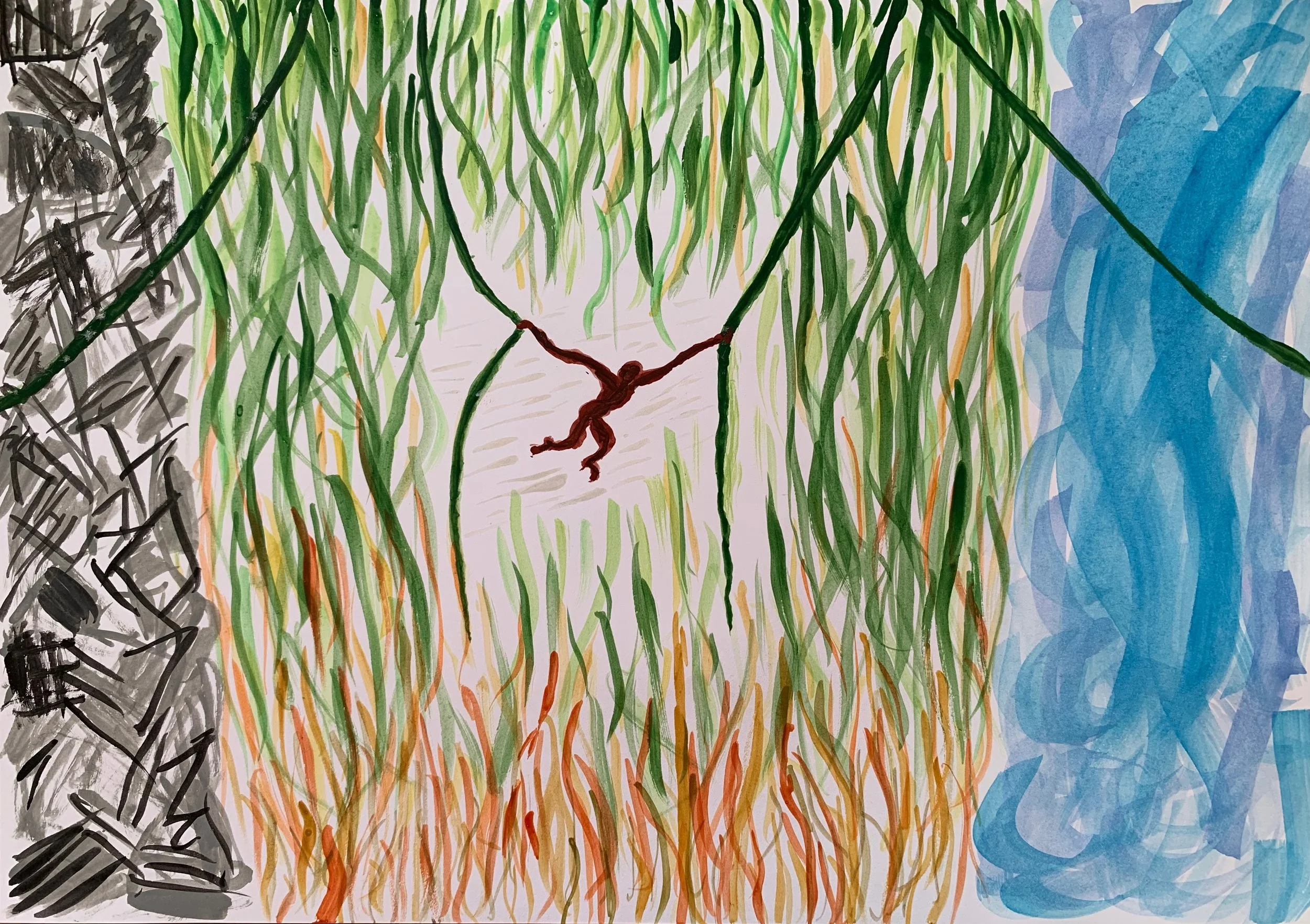
But to truly grasp an insight, you have to endure the discomfort of Nothingness. The transition only happens when you let go of the old vine to reach for the new one.

That means you need an environment where it's safe to be in that critical moment. Someone more experienced and mature holds the perimeter and takes care of you.

Then your chances of crossing the threshold of the River of Life safely become much higher.

Throughout history, Ritual helped people do exactly this.

Until modern man decided it was all nonsense and superstition.

And ever since, he’s been getting hopelessly stuck where nothing is actually holding him.

There’s nothing worse than blocking the flow of Being with your own body.

Why create and maintain Hell with your own hands?

There’s good news, too.

Turning a tragic situation around doesn’t require sacrifice or superhuman effort.

You can begin by accumulating experiences of “mad” being:

  • engaging creative work of any kind,

  • deep play,

  • genuine love,

  • a profound ordeal,

  • contemplating Beauty,

  • authentic prayer,

  • a living encounter with the Other,

  • voluntary uncertainty,

  • symbolic work (dreams, active imagination, guided imagery),

  • ritual.

​Sincerely yours,​

​-Alexander​


As a business therapist, I help tech founders quickly solve dilemmas at the intersection of business and personality, and boost company value as a result.

Stuck? Your business grows when you do. I’m your business therapist to guide your shift. See testimonials ​here​. Ready? ​Book your Catalyst session​.


Nightmare or Dream? /  by Alexander Lyadov

Long-term study of many dreams begins to reveal patterns.

Dreams reflect the quality of the relationships between different aspects of the personality (parts, archetypes), as well as their relationship with the Ego. In other words, the structures of the unconscious interact both with consciousness and with one another.

Well, "interact" might be too polite a word. Sometimes it's arguments, fights, or full-scale battles. There are even murders, but fortunately, death is never the end there.

What's more interesting is this. Even if a particular part behaves with extreme hostility at first, over time the relationship can evolve into respect and even affection, while fighting each other gives way to a shared mission.

Of course, that takes work: psychotherapy, dream analysis, and so on. Otherwise, your dreams get stuck playing the same record by a band called "Nightmare."

The part that filled me with disgust or terror ten years ago is now an indispensable piece of the puzzle, finally closing a hole inside me.

It turns out that when I was stung by an insect or chased by a boar, a rejected part of my personality was trying to get my attention. Unfortunately, as long as I was afraid of making contact with it, we both suffered.

Everything changed when I allowed myself to consider, within my dreams, that strange, disturbing, and even crazy behavior is not its function, but merely its form. A bite or a jab is a primitive way of making contact without words.

That's how the part I had forgotten shows its interest in me. It's tired of being alone and wants to be integrated into the whole.

The only question is: "Am I ready?"

​Sincerely yours,​

​-Alexander​


As a business therapist, I help tech founders quickly solve dilemmas at the intersection of business and personality, and boost company value as a result.

Stuck? Your business grows when you do. I’m your business therapist to guide your shift. See testimonials ​here​. Ready? ​Book your Catalyst session​.


Garden. Forest. Cosmos. /  by Alexander Lyadov

Demand for authenticity is growing exponentially around the world.

It’s easy to see why. Social media and traditional media alike are bursting with cookie-cutter content. Everywhere you look, it’s the same playbook: clickbait headlines, storytelling, and cliffhanger endings.

The problem is that every act of copying hollows out whatever substance was there to begin with. And the harder a product tries to stand out in form, the harder it becomes to tell it apart from everything else.

No wonder people feel deceived. They came hungry, hoping for real, nourishing food, but all they’re offered is soda, chips, and cotton candy.

Nothing new is born. There is only repackaging of the already known.

Even when someone decides, “That’s it. I’ll create something from scratch,” he hits a false start. It turns out he’s forgotten how. His subconscious has been saturated with fake content for far too long.

Inside, there’s only plastic, concrete, and asphalt, but no soil. The seeds of novelty fall within, but sadly, they can’t take root.

AI turned out to be not water, but gasoline poured onto that fire. Enthusiasts dreamed AI would unleash human creativity. So far, the opposite seems to be happening. Every form of dependency is growing.

But the “machine” isn’t to blame. The temptation to imitate someone else’s “paradise” instead of creating your own has always existed, and always will.

AI could potentially become a genuine creative partner. But for that to happen, a person would have to grow sick to death of performing himself rather than being himself.

Then comes the surprise: he doesn’t actually know his authentic self.

That’s where the difficult but fascinating journey begins.

Amid the asphalt and concrete, a person creates his own Garden. Forest. Cosmos.

​Sincerely yours,​

​-Alexander​


As a business therapist, I help tech founders quickly solve dilemmas at the intersection of business and personality, and boost company value as a result.

Stuck? Your business grows when you do. I’m your business therapist to guide your shift. See testimonials ​here​. Ready? ​Book your Catalyst session​.


Friction Is Good /  by Alexander Lyadov

Friction between business partners is common.

Some people find this discomfort unnecessary — even dangerous. Most have experienced the chain firsthand:

friction → argument → conflict.

Empathetic, inexperienced, and naive people simplify the picture:

friction = conflict.

The problem is that they're all right — but only probabilistically. Every corporate war once started as a minor misunderstanding.

When two people build something together, there's a chance one will destroy the other. That risk is not zero — criminal statistics confirm it. But deception, reputation damage, or legal pressure are far more likely.

There are other scenarios too, and they’re much more likely. I remember co-founders who constantly tore into each other during meetings where we presented advertising concepts. Their partnership is still thriving today.

Friction only disappears when partners are identical. Unfortunately, that also means giving up any hope of sustained business growth.

Uniformity is physically incapable of creating anything new.

To put it simply: something new emerges where X meets Y.

Notice, not X₁-X₂ or Y-Y′. That’s simply reproducing what’s already known.

Differences are necessary — but not sufficient. What matters is accepting friction as inevitable, understanding its value, and learning to manage it: calibrate it, turn it on, turn it off.

In partnership, a paradox emerges: constructive conflict.

Your business is fueled by the very thing that destroys everyone else's.

Sincerely yours,

-Alexander


As a business therapist, I help tech founders quickly solve dilemmas at the intersection of business and personality, and boost company value as a result.

Stuck? Your business grows when you do. I’m your business therapist to guide your shift. See testimonials ​here​. Ready? ​Book your Catalyst session​.


Living Light /  by Alexander Lyadov

Unknown photographer

During my travels, stained glass windows in churches always intrigued me.

It wasn't the depth of the stories, the craftsmanship, or the brilliance of the colors.

Paintings and statues need your imagination to come alive.

Stained glass is always alive — light passes through it from the other side.

Sunlight moves unpredictably, playing and dancing like children.

It feels as though the familiar world has turned itself inside out.

Now you are standing outside, looking through a window into the vibrant life within.

The stained glass has become a Portal through which you can glimpse the Source.

You are here. It is there.

But through the colored rays, you are in contact with It.

Who is It? What is this Source? What light are we talking about?

It's a metaphor for your own personality.

The Source — the deep center of the personality, the Self.
The Light — vitality, libido, Eros, the very energy of life.
The stained glass — dreams as messages from the Self to the Ego.
The temple — all your structures: body, mind, and psyche.

Everything is in its proper place. Everything has its function.

All that remains is not to turn away, but to look up and recognize this Beauty.

All that's needed is not to look away, but to lift your eyes and take in this Beauty.

Sincerely yours,

-Alexander


As a business therapist, I help tech founders quickly solve dilemmas at the intersection of business and personality, and boost company value as a result.

Stuck? Your business grows when you do. I’m your business therapist to guide your shift. See testimonials ​here​. Ready? ​Book your Catalyst session​.


Quietly Waiting /  by Alexander Lyadov

You're watching a colleague, a relative, or a friend.

He keeps stumbling over the same thing and complaining about it out loud.

He goes in circles. Misses opportunities. Fails to see the risk.

Your first impulse is to share your perspective.

Stop. Last time you did, he pushed back hard.

He brushed it off. Took offense. Dismissed it.

Does he actually enjoy stumbling? Why does he do this?

For now, he is not ready to receive anything from you, or from anyone else.

So what can you do?

You can pray for him. But you cannot force yourself on him.

Assuming, of course, that he is an adult, not a child.

Out of respect for his freedom to choose, you stay nearby and wait in silence.

While he keeps bumping his head and cursing his unfair fate.

And if you truly care about him, it will not be easy.

Accepting your own powerlessness to change anything.

Trusting his ability to change on his own.

Maybe one day he'll say: "You know, I should have listened to you back then."

You'll answer: "No. It was right. It's your life, not mine."

And both of you will realize that you had been there all along. Just as now.

Now for a plot twist.

He is me. Or you. Or all of us.

The one who isn't yet ready to take in another's perspective.

The one who protects his Ego, unable to tolerate the "wrong kind" of novelty.

The one who keeps stepping on the same rake and missing unique opportunities.

Meanwhile, the one who loves me quietly waits until I am ready.

Sincerely yours,

-Alexander


As a business therapist, I help tech founders quickly solve dilemmas at the intersection of business and personality, and boost company value as a result.

Stuck? Your business grows when you do. I’m your business therapist to guide your shift. See testimonials ​here​. Ready? ​Book your Catalyst session​.


I Am Here /  by Alexander Lyadov

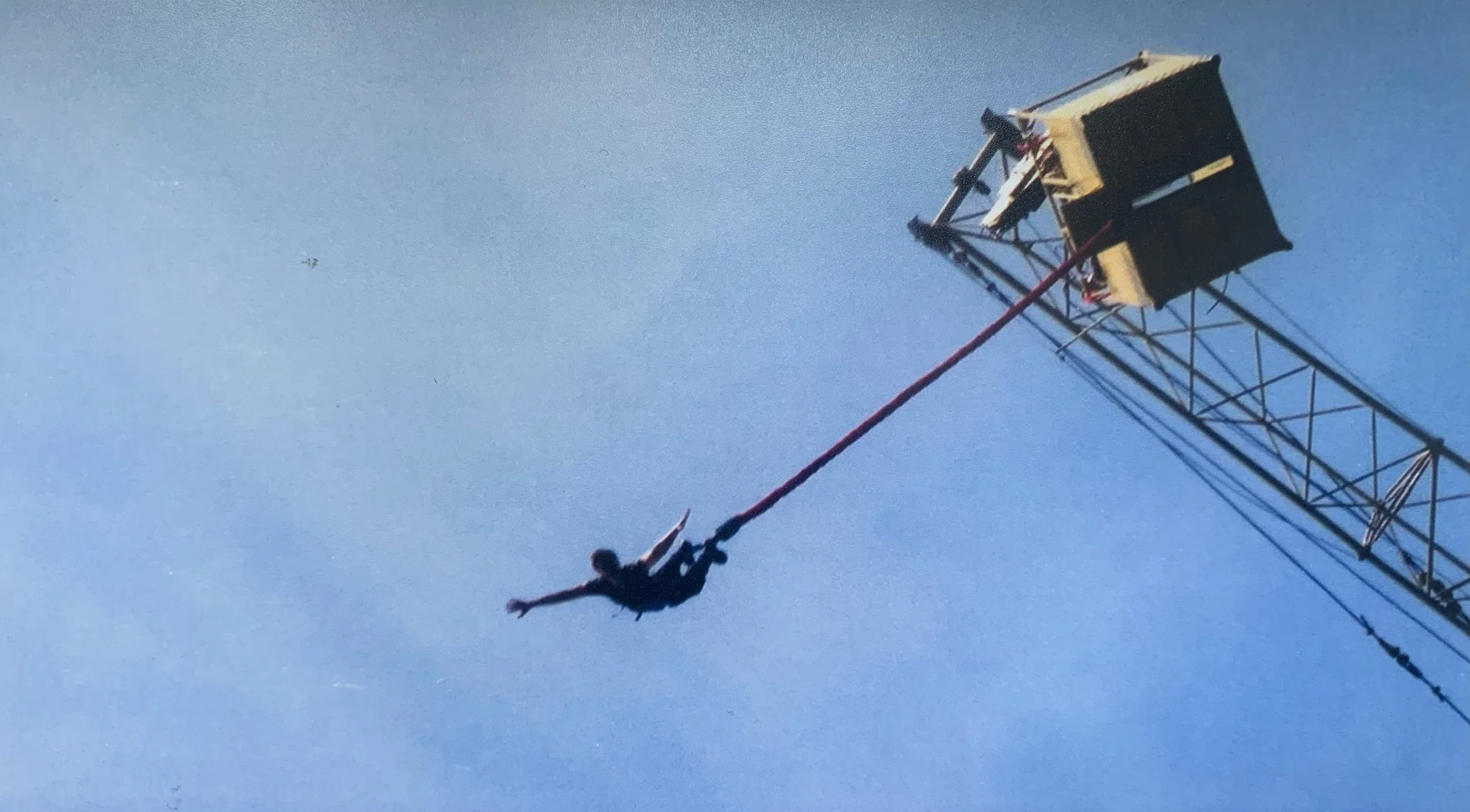
I made my first bungee jump almost 30 years ago.

Yet I am still drawing insights from that experience.

For example, while falling, I was surprised to notice my clenched fists.

It was useless and absurd — but I kept grabbing at the air.

Only at the end, near the ground, was I able to open my hands.

That happened when I realized I was not going to die this time.

Only then did fear turn into euphoria.

Apparently, even Emptiness in your hands is better than Nothing at all.

The very act of grasping, however slightly, still calmed me down.

During my first parachute jump, a procedure served the same purpose.

The moment I stepped out of the plane, I became preoccupied with the checklist: “Did the canopy open? Are the lines twisted? Did I disable the reserve chute?”

By the time I'd worked through every step, I was completely calm.

Looking around, I realized I was suspended between earth and heaven.

In that moment, the whole world was divinely beautiful.

With fear gone, exhilaration filled my vessel to the brim.

What is the takeaway?

When we encounter the Unknown, fear is natural and inevitable.

Fear can become absolute, and then you are finished. You disappear.

Anything that helps you feel "I exist" will do.

I am the One Who Does something, anything: notices, acts, feels.

I am here, even when Chaos is all around me.

Sincerely yours,

-Alexander


As a business therapist, I help tech founders quickly solve dilemmas at the intersection of business and personality, and boost company value as a result.

Stuck? Your business grows when you do. I’m your business therapist to guide your shift. See testimonials ​here​. Ready? ​Book your Catalyst session​.


Together... Where? /  by Alexander Lyadov

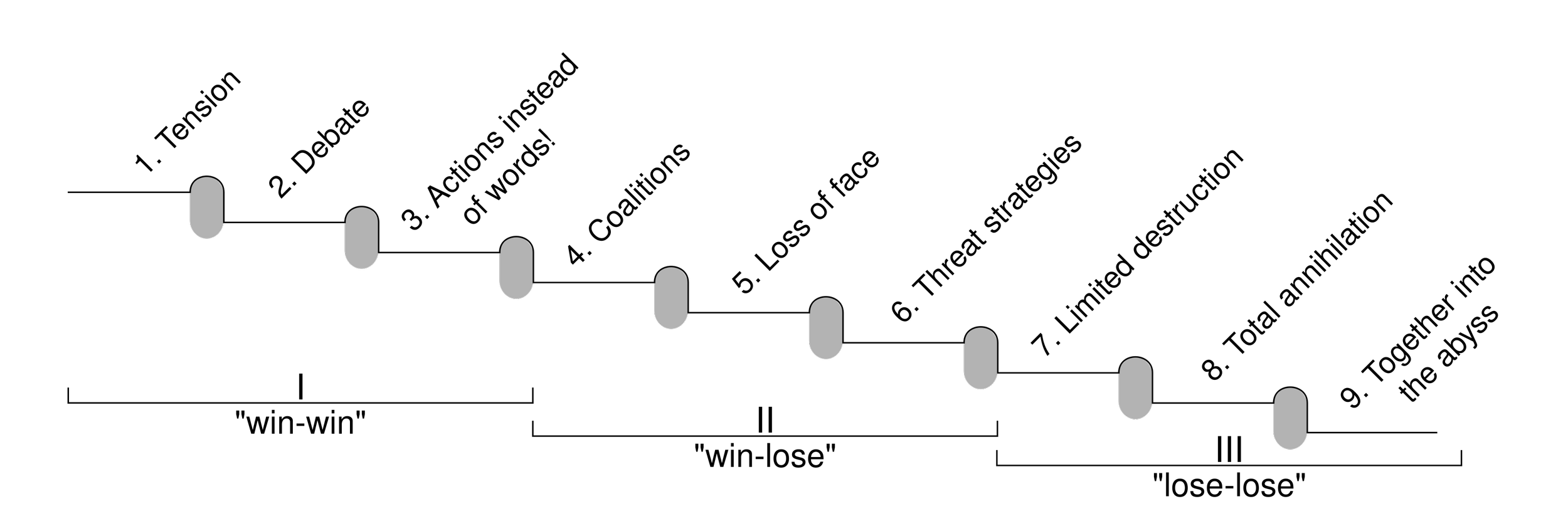
Long ago, I came across ​Friedrich Glasl's conflict model​ and fell in love with it.

It describes nine vivid stages in the breakdown of human relationships.

It's worth thinking about the two extremes — the first stage and the last.

The end comes when one side wants to destroy the other, even at the cost of destroying itself.

"Together into the Abyss" is the final turn of the downward spiral.

Now look at how fruitfully it all begins.

"Tension" certainly brings confusion, irritation, and discomfort.

But it is also the necessary condition for creative synthesis. Any sculptor, composer, or screenwriter will tell you the same.

Everything genuinely new is born in heat and tension. An electrician would say that without a difference in potential, no electric current flows.

Uniformity and sameness cannot produce anything. There has to be some difference. And the greatest creative potential lies in opposites.

So, Glasl's nine stages of conflict tell only half the story. There is another half that remains hidden from view.

A physicist might say that "Tension" resembles a bifurcation point.

The system can collapse downward... or soar upward.

Then the opposing forces stop fighting and start collaborating

The final stage of their co-creation is called "Together into Paradise."

Down or up — the choice is yours.

Sincerely yours,

-Alexander


As a business therapist, I help tech founders quickly solve dilemmas at the intersection of business and personality, and boost company value as a result.

Stuck? Your business grows when you do. I’m your business therapist to guide your shift. See testimonials ​here​. Ready? ​Book your Catalyst session​.


Build the Vessel /  by Alexander Lyadov

If I don't have something, perhaps it's because I'm not yet ready to receive it.

That thought came to me while reflecting on archetypes.

Do you remember those moments when everything feels possible? Your energy overflows, your body is filled with joyful boldness, and your mind with fresh ideas.

Like a paraglider caught in a thermal — a rising column of warm air.

For a while, you feel unstoppable and invincible. Things seem to fall into place on their own... until something suddenly goes wrong.

At best, luck turns against you and your plans fall apart. At worst, the paraglider collapses and plunges from a great height.

One incident is easy to dismiss as bad luck. But what if the same ridiculous pattern keeps repeating itself? Am I cursed or something?

What would you say if water spilled because you poured too much into a vessel?

A few of my own guesses — add yours:

"I was too generous, misjudged the volume, and poured too much."

"I was impatient and rushed. My movements were too abrupt."

"I didn't know the vessel had a crack. I'll need to seal it."

The problem is not the water. It is your judgment, your coordination, or the vessel itself.

Now replace the vessel with your personality, and the water with life force.

Inside each of us is an inexhaustible reserve of psychic energy. Access opens through contact with archetypes. But there are two difficulties: the first is making the connection; the second is not letting it flood you.

Without this energy, stagnation, despondency, and depression await. The work is to methodically build up the walls of the personality "vessel" — to hold a greater volume.

Of what?

The force to live, to love, and to create.

Sincerely yours,

-Alexander


As a business therapist, I help tech founders quickly solve dilemmas at the intersection of business and personality, and boost company value as a result.

Stuck? Your business grows when you do. I’m your business therapist to guide your shift. See testimonials ​here​. Ready? ​Book your Catalyst session​.


Remember the Creator /  by Alexander Lyadov

Once the "machine" is running, it's easy to forget who built it.

It can be anything: a concept, a business, a system, a mechanism.

Every process is tuned. Every error is catalogued. Each area has its specialist. Breakdowns have repair algorithms. The executive has both a daily plan and a five-year plan.

The current state of affairs feels real, reliable, fundamental. As if it always was, is, and always will be.

Faded memories of the early days get a chuckle:

“When I arrived, this place was a mess,” says the CEO. “Everything was held together with duct tape and enthusiasm. We had to change almost everything.”

But let that same CEO build something from scratch. Something where the grimy little "machine," creaking and smoking, somehow manages to move on its own.

Easier said than done.

Only 20–25% of new corporate ventures become viable and scalable [1, 2]. Even buying successful, growing companies doesn't help — 60 to 90% of major M&A deals fail to deliver the results CEOs promised their boards [3, 4].

Creating something new and improving something that already exists aren't different skills — they're fundamentally different ways of perceiving the world and oneself. Compare a spacewalk to a bungee jump.

Ironically, most founders appreciate the value a professional manager brings. But few managers appreciate the entrepreneurial contribution. The chaos of the early stage is mistaken for naivety and simplicity.

A good way to humble your ego is to spend a little time creating something yourself. Paint a dream that deeply moved you. Sculpt from clay a symbol of what torments or inspires you. Write a short story, a melody, or an essay.

The hierarchy becomes obvious:

The Creator comes first. The creation comes second.

Sincerely yours,

-Alexander

References

  1. McKinsey & Company. Derisking corporate business launches: Five steps to overcome the most common pitfalls (2020).

  2. McKinsey & Company. Why business building is the new priority for growth (2020).

  3. Harvard Business Review. The New M&A Playbook (2011).

  4. Harvard Business Review. A Better Approach to Mergers and Acquisitions (2024).


As a business therapist, I help tech founders quickly solve dilemmas at the intersection of business and personality, and boost company value as a result.

Stuck? Your business grows when you do. I’m your business therapist to guide your shift. See testimonials ​here​. Ready? ​Book your Catalyst session​.


Chaos University /  by Alexander Lyadov

Stanley Hall, 1954

I have a folder called “Survival” where I save videos of encounters with Chaos:

First and foremost, this is the world's best university — and it's free.

I enrolled while learning to ride a motorcycle. A couple of close calls convinced me there had to be a better way to gain experience. It turned out YouTube was full of first-person crash videos.

Watching it was unpleasant, of course. But afterward, on the road, my body would send a signal in advance: "Hey, this looks like that video. Get out of the way." Thanks to other people's experience, my situational awareness quietly grew.

Getting acquainted with Chaos was too valuable to limit to motorcycles — it has countless faces. The unknown lies in wait everywhere, especially where we least expect it.

Useful as it is, the further I go, the more Chaos fascinates me. It becomes clear just how colossal the forces are that hunger for contact with us — in nature, in animals, in society, in other people, and most of all in ourselves.

You can naively ignore them, then react with resentment and outrage. Or you can study them patiently and even choose to enter into a conscious relationship with them.

Chaos evokes what the German theologian and religious scholar Rudolf Otto described as:

“A mystery that is at once terrifying and fascinating.”

(Mysterium tremendum et fascinans)

Dial the risk down to an acceptable level, and this mystery becomes worth exploring.

Sincerely yours,

-AlexanderSincerely yours,

-Alexander


As a business therapist, I help tech founders quickly solve dilemmas at the intersection of business and personality, and boost company value as a result.

Stuck? Your business grows when you do. I’m your business therapist to guide your shift. See testimonials ​here​. Ready? ​Book your Catalyst session​.


The Click /  by Alexander Lyadov

When I started this newsletter six years ago, I made a deal with myself:

Always write only about what genuinely grips me.

Which means doing everything I can not to write about everything else. That is, about the billion phenomena, events, and things I "should" write about — what's popular, sensible, correct, safe, profitable, and so on.

In practice, this means waiting for the "click" — half an hour, an hour, sometimes two. All that time I'm in serious discomfort, digging through a pile of thoughts, images, dreams, and quotes, muttering over and over:

“No. Not it. Wrong. Hmm… yes, that’s good, but no… it doesn’t grab me.”

The Critic in my head chimes in:

"This is so stupid. All this effort for nothing. Just make a content plan and crank it out. Write what's guaranteed to hook everyone."

I can’t. Or rather, I don’t want to. I’ve already had enough of that. “Make the client happy.” Ads, promotions, marketing. "The client is always right."

My "target audience" now is an unknown part of myself. Or more accurately, I am a part of it. Jung called the Self the deep center that unites consciousness and the unconscious.

We work in tandem — I search and write, and the Self accepts or rejects.

That might sound selfish, if not for one thing.

Jung believed the psyche of the individual is rooted in the archetypal structures of the collective unconscious. Eliade wrote about a single pattern of Being that manifests in the Cosmos, in society, and in the individual.

We are like individual mushrooms connected underground by one mycelium.

That explains why my essays sometimes resonate with you. When I do my job well, I touch a point of authenticity we share.

It's worth trying again and again for that — don't you think?

Sincerely yours,

-Alexander


As a business therapist, I help tech founders quickly solve dilemmas at the intersection of business and personality, and boost company value as a result.

Stuck? Your business grows when you do. I’m your business therapist to guide your shift. See testimonials ​here​. Ready? ​Book your Catalyst session​.


Another World Nearby /  by Alexander Lyadov

It's a shame that people today so rarely see a starlit sky.

Many of our problems would simply vanish on their own.

Direct contact with infinity restores our bearings.

Cynicism, scientism, and egocentrism lose their grip.

We feel with our whole being what words cannot describe.

A storm, a hurricane, or a volcano can produce the same kind of “reload.” But if your eye is trained, so can the life of clouds or even an anthill.

It all comes down to your ability to see another world.

The one that always was, is, and will be, Following an unknown plan, rhythm, and purpose, Constantly changing — or standing perfectly still.

We have a choice: reduce this experience to a template. Or take off the protective glasses and let it change us, even just a little.

If that happens, the hole inside closes. The emptiness dissolves. In place of the usual doubts, disappointments, and anxieties — abundance, harmony, and peace.

That is why people say:

People say it afterward: "The desert heals." Or the ocean. Or the mountains.

But these medicines are within reach right now.

Just stretch out your hand and take them.

Sincerely yours,

-Alexander


As a business therapist, I help tech founders quickly solve dilemmas at the intersection of business and personality, and boost company value as a result.

Stuck? Your business grows when you do. I’m your business therapist to guide your shift. See testimonials ​here​. Ready? ​Book your Catalyst session​.


Hard Eye /  by Alexander Lyadov

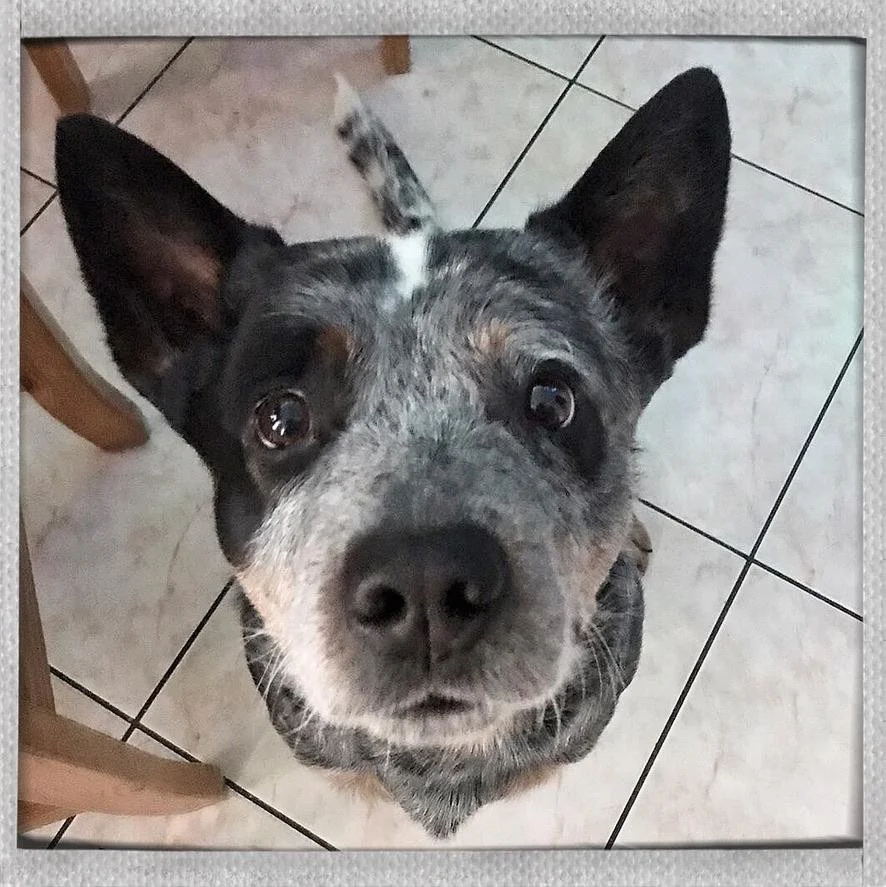
My Australian Cattle Dog (blue heeler)

My dog has a habit that could drive anyone crazy.

He often fixes me with an intense stare. He doesn't bark. He doesn't whine. He doesn't blink. He simply drills straight through me.

Sadly, it took me ten years of living together to discover his "secret."

It is not aggression or just a personality trait. It is a ​working tool​. As a herding breed, the Australian Cattle Dog uses it to control cattle and sheep by locking onto them with his gaze and making them turn where he wants them to go.

The breed descends from the wild dingo, which gave it that cold, unblinking, predatory stare. If the stare is not enough for a stubborn bull, the dog fearlessly nips him on the heel.

Most of the time, however, the stare alone is enough. It is impossible to ignore. Even a powerful bull finds it easier to do what the dog wants. The predator's gaze turns him into prey.

Unlike the dingo, however, the Australian Cattle Dog has a shepherd. He does not hunt for himself. He carries out a higher command. That is why he constantly checks in with his eyes, as if asking:

"Boss, what do you need me to do now?"

I cannot help wondering whether I should learn something from my dog.

After all, the quality of your attention determines everything in life:

  • noticing anomalies,

  • building relationships,

  • revealing what is implicit,

  • reading the meaning of symbols,

  • freeing yourself from illusions,

  • becoming a different person,

  • and whether uncertainty turns against you or works in your favor.

Sincerely yours,

-Alexander


As a business therapist, I help tech founders quickly solve dilemmas at the intersection of business and personality, and boost company value as a result.

Stuck? Your business grows when you do. I’m your business therapist to guide your shift. See testimonials ​here​. Ready? ​Book your Catalyst session​.


Look Past It /  by Alexander Lyadov

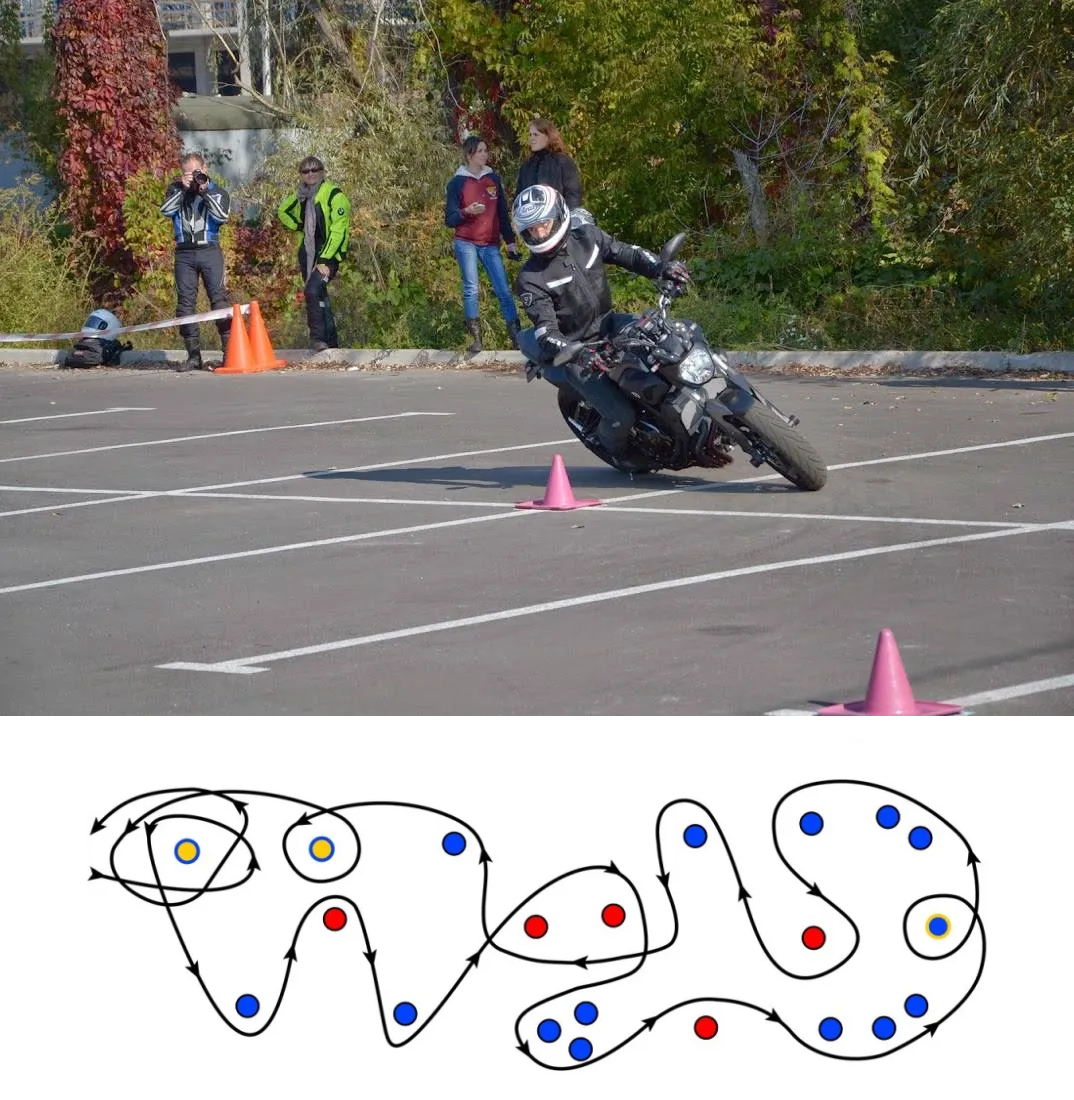
Moto Gymkhana Competition, October 5, 2014

When my motorcycle instructor had me weave around cones, he said:

"Don't look at the obstacle — look past it."

Hmm. That sounds strange. I'd rather look directly at whatever is in my way. That's how I choose the safest, easiest, and most efficient path.

That is the logic of the Mind. It is convincing as long as it stays in your head, in ideal conditions, without stress or time pressure.

In the physical world, though, the motorcycle drives straight into the first cone. The cone pulls it in like a magnet pulls metal. The chain reaction goes like this:

Eyes → Body → Bike.

You have no choice but to trust the instructor. His advice sounds absurd. “Ride without looking at the obstacle?” Isn’t that a recipe for a crash?

The first attempt delivers the insight — the body already knows what to do and how.

Focusing your gaze past the cone sets the vector of your goal. Peripheral vision reads the full context. While the mind stumbles, the body steers the horse.

All you had to do was not let the obstacle become the destination.

If an obstacle is paralyzing you right now, direct your gaze beyond it.

Keep your eyes on the goal you truly want.

Trust your body.

Sincerely yours,

-Alexander


As a business therapist, I help tech founders quickly solve dilemmas at the intersection of business and personality, and boost company value as a result.

Stuck? Your business grows when you do. I’m your business therapist to guide your shift. See testimonials ​here​. Ready? ​Book your Catalyst session​.


Moon and Finger /  by Alexander Lyadov

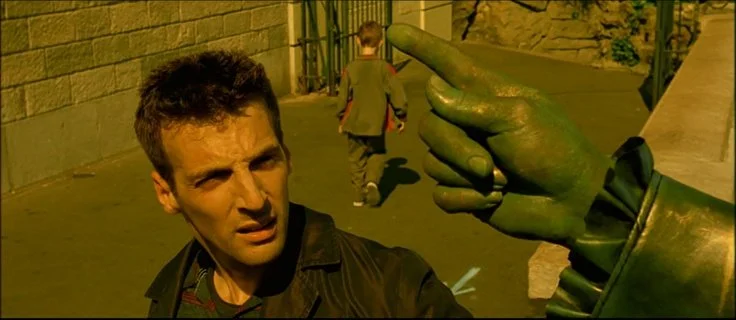
In the film Amélie (2001), a boy says to a man standing near a monument:

“Sir, when a finger points at the moon, a fool looks at the finger.”

The line captures one of the biggest problems people face in business and in life.

Imagine the early days of a company. The founder has just launched it. Revenue and profits are growing. Customers cannot contain their excitement. A vague idea has taken concrete form, and its shape is beautiful.

Years go by. Top executives succeed one another at the helm. The company grows into an industry leader and expands internationally.

Everyone tries to study and copy its business model, its methods, and its know-how. Harvard Business School writes glowing case studies about it.

Then something strange happens. In just a few years, this once-solid pillar of stability turns into a ghost. Analysts, investors, and journalists are baffled.

Why?

The company has become the finger that drew everyone’s attention to itself. Or rather, people became fixated on the form and forgot that it was only ever pointing at something beyond itself.

So what is the moon in this metaphor?

The creative act of solving a painful problem for customers.

Not the strategy.
Not the organizational structure.
Not the business model.
Not the team.

The finger was always pointing to someone’s intention:

“It seems nobody cares.”
“But I can’t leave it this way.”
“This is where I can, and want to, set a small part of the Cosmos right.”

Could that company have been saved?

Yes.

If it had regularly turned its gaze to where the boy advises.

Sincerely yours,

-Alexander


As a business therapist, I help tech founders quickly solve dilemmas at the intersection of business and personality, and boost company value as a result.

Stuck? Your business grows when you do. I’m your business therapist to guide your shift. See testimonials ​here​. Ready? ​Book your Catalyst session​.


Grateful for the Difference /  by Alexander Lyadov

​Iain McGilchrist, a British psychiatrist, philosopher, and neuroscientist, spent many years studying the asymmetry of the human brain. In his words, the difference in functions solved the fundamental problem —

"How to eat without being eaten."

These aren't simply two hemispheres. They are two entirely different ways of perceiving and experiencing the world.

The left hemisphere sees the world as a collection of separate objects that can be analyzed and manipulated logically. It tries to make the environment known, controllable, and predictable. Unfortunately, once it builds a model of reality, it begins to mistake the model for reality itself.

The right hemisphere perceives the world in its wholeness, ambiguity, and implicitness. It remains open to novelty and tries to stay connected with what always remains Unknown. The right hemisphere can make mistakes in its perception of a situation as well.

What matters is this: the left hemisphere is incapable of performing the functions of the right — and doesn't even consider them valuable. The right, on the other hand, can sometimes step in and perform the functions of the left, and recognizes the value of its contribution.

This helped me understand a strange pattern I had seen in business partnerships, when conflict emerges between two partners who, broadly speaking, rely primarily on left- and right-hemisphere ways of engaging with the world. I've watched it play out in others. I've lived it myself.

Once, my business partner said to me, “I'm the logical one, and you're the intuitive one.” At the time, I could never understand why he failed to notice or value my contribution, while I noticed and valued his.

As a result, our partnership kept stumbling. We made costly mistakes that I often sensed in advance but couldn't prove to him in iron-clad terms. After all, they were just my “vague feelings,” “paranoid fantasies,” and “unclear hunches.”

Many years later, we met again, and my former partner was genuinely curious about the way I perceive the world. Experience had taught him that one person's advantage lies in the other person's difference.

Differences between partners are essential for stable, rapid business growth. But everything depends on maturity.

Want a simple indicator?

Ask whether each partner is genuinely grateful that fate brought him someone who is nothing like him.

Sincerely yours,

-Alexander


As a business therapist, I help tech founders quickly solve dilemmas at the intersection of business and personality, and boost company value as a result.

Stuck? Your business grows when you do. I’m your business therapist to guide your shift. See testimonials ​here​. Ready? ​Book your Catalyst session​.


The Cornerstone /  by Alexander Lyadov

It's commonly assumed that madness means losing one's reason — the coherence of thought, logic, the ability to reason clearly.

In reality, the opposite is often true.

Don’t believe me? Talk to a schizophrenic.

He will describe a flawless system where every element fits perfectly and every cause-and-effect relationship seems rock solid.

Yet something inside you will begin to whisper, “Hmm… something isn’t right.” The impression that there's a crack in the foundation — but it's buried deep.

Take this: it doesn't matter how skilled the doctor is, how powerful the latest drugs are, or how sophisticated the equipment — if the patient has no will to live.

Or the world's greatest dog trainer can use every trick in the book — and it will all amount to nothing — if a Chihuahua was chosen to herd the flock instead of an Alabai.

Likewise, reconciling partners or spouses is impossible if their conflict has already reached the ninth stage on Friedrich Glasl's scale: "Together into the abyss."

There is always something unique that makes everything else possible.

The cornerstone — the sacred stone that in ancient times was laid first in the foundation of a building. The point of reference. The origin of coordinates.

It is the point where Reality and human action meet. Get this wrong, and the effort, the blueprints, the materials, and the number of floors become meaningless.

After all, the fundamental rule of architecture is that a building must fit its context, not the other way around. Think of an expensive, stylish house that sticks out in a city like a bone in your throat.

Local beauty, cut off from its surroundings, becomes ugliness.

In 1908, G. K. Chesterton wrote:

“The madman is the man who has lost everything except his reason.”

Do you want to preserve your sanity?

Learn to value everything your mind is quick to dismiss.

Sincerely yours,

-Alexander


As a business therapist, I help tech founders quickly solve dilemmas at the intersection of business and personality, and boost company value as a result.

Stuck? Your business grows when you do. I’m your business therapist to guide your shift. See testimonials ​here​. Ready? ​Book your Catalyst session​.


Baking Dreams /  by Alexander Lyadov

My therapist says my mind works like a blast furnace. Every morning I get tired of writing down insights and dreams. They come out as reliably as baguettes and croissants from a French bakery.

The more I value my dreams, the more productive the furnace becomes.

When I wake up in the middle of the night, the temptation is to fall back asleep. Especially since the dream often feels like complete gibberish. I try to capture at least a few key words. Understanding comes later.

Dreams are like diamonds extracted from the earth or the ocean floor. In raw form they're already worth $2,000–4,000 per carat — and after cutting, $5,000–15,000. The cutting is your interpretation of the dream.

Despite my experience in this area, if I were helping you, I would encourage your own response first — what memories and associations come up, what a particular element means to you personally.

No element of a dream is accidental. Every symbol contains an entire cluster of meanings.

When I shared some of these "treasures" during a group psychotherapy session, it turned out my interpretations were even more interesting than the dreams themselves. That is the effect of cutting the diamond. It reflects far more light.

So what are dreams to you — waste product of the brain, or ancient treasure?

Sincerely yours,

-Alexander


As a business therapist, I help tech founders quickly solve dilemmas at the intersection of business and personality, and boost company value as a result.

Stuck? Your business grows when you do. I’m your business therapist to guide your shift. See testimonials ​here​. Ready? ​Book your Catalyst session​.


Alone with Implicit /  by Alexander Lyadov

Once something tangible already exists, the greatest uncertainty is gone.

Someone else's behavior can be admired and imitated. A finished product can be reverse-engineered. Even a drawn map is a way out of the labyrinth.

It's a different story when there's no model, no prototype, no template. The need is real, but there's nothing to grab onto. Like falling from a great height.

That is why creating something out of nothing is the hardest thing of all.

The process itself is mysterious, strange, and unpredictable. That unsettles and irritates a lot of people. To protect themselves, they pretend the creative process is unimportant. It exists, yet somehow it does not.

People notice a new phenomenon only when it becomes impossible to ignore. Society's attitude shifts like an avalanche. No. No. No. Then suddenly, yes.

Until that moment, the creator feels like he's losing his mind. No one seems to see what is so obvious to him. When he tries to share his excitement, he's met with hostility, dismissal, and ridicule.

Perhaps patience is what separates an experienced creator from a beginner.

Noticing and valuing what isn't yet visible to others — that's both a gift and a curse.

Which is greater?

That depends on how much the Ego needs other people's recognition.

Blessed is the one who forgets himself and everyone else in the act of creation.

Sincerely yours,

-Alexander


As a business therapist, I help tech founders quickly solve dilemmas at the intersection of business and personality, and boost company value as a result.

Stuck? Your business grows when you do. I’m your business therapist to guide your shift. See testimonials ​here​. Ready? ​Book your Catalyst session​.